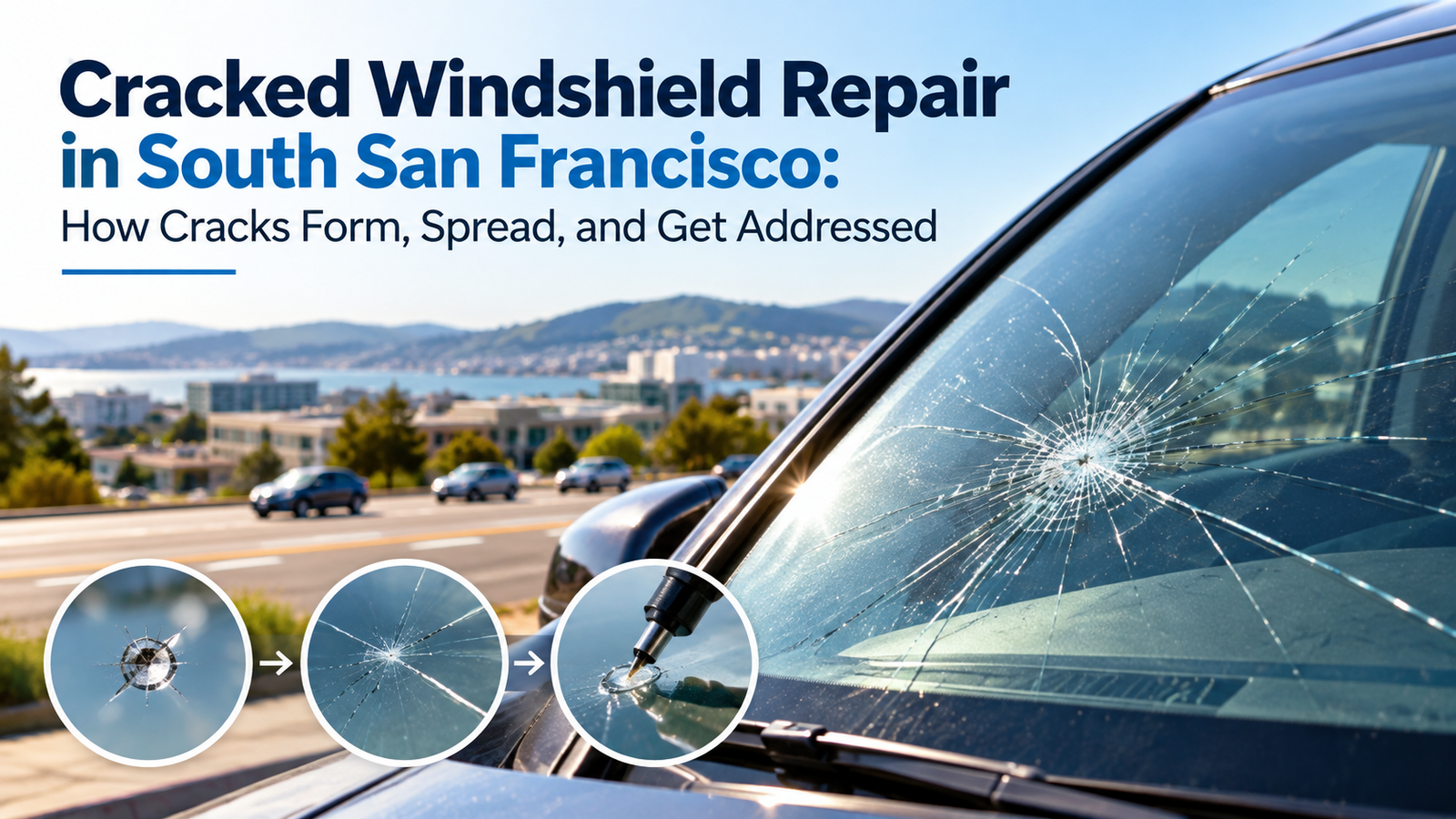
A crack in a windshield tells a different story from a chip. A chip is a point of damage, a small wound where an object struck the glass. A crack is a line, and a line has direction, length, and momentum. It can sit quietly for weeks, or it can run from one side of the glass to the other in the time it takes to close a door on a cold morning. For drivers trying to make sense of a crack, the useful questions are how it formed, how it behaves, whether it can be repaired, and what conditions in their own area make it more or less likely to grow.
This article explains how cracks develop in laminated Cracked Windshield Repair South San Francisco glass, the different crack types and what each one means, how repair works and where its limits lie, and why a city like South San Francisco, with its wind, hills, freeway traffic, and shifting temperatures, shapes the whole picture. It is general information intended to help readers understand what is happening in the glass in front of them.
Why Glass Cracks at All
Glass is strong in compression and surprisingly vulnerable in tension. Its surface is covered in microscopic flaws that are invisible to the eye. Under ordinary conditions those flaws do nothing. When stress concentrates on one of them, the flaw can open and propagate as a crack.
A windshield is laminated, which means two layers of glass are bonded to a plastic interlayer. That construction holds the pieces together after a break, which is why a cracked windshield remains in one piece. But the outer glass layer can still crack, and cracks in that layer are what drivers see.
Stress that starts cracks comes from several sources.
Impact. A stone, tool, or other hard object striking the outer surface.
Thermal stress. Uneven heating or cooling across the glass, which makes one area expand faster than another.
Mechanical stress. Flexing of the vehicle body from rough roads, torsion from parking on uneven ground, or pressure from slamming doors.
Installation stress. A windshield that was fitted with uneven pressure, a pinched edge, or a poor bond can develop cracks over time.
Existing damage. An unrepaired chip is a stress concentrator and a common starting point for a crack.
The Main Types of Cracks
Cracks come in recognizable forms, and the form often reveals the cause.
Chip-origin cracks. These start from an impact point and extend outward, either as a single line or as several legs. They are the most common type, and the crack often grows from a chip that was left unrepaired.
Stress cracks. These appear without any visible impact. They start near the edge of the glass or at a corner and usually result from thermal or mechanical stress. They often begin as a short line and extend over time.
Edge cracks. A crack that starts within a couple of inches of the glass perimeter. These are especially prone to spreading because the glass near the edge is held rigidly by the bond and experiences higher stress.
Floater cracks. A crack that starts in the middle of the windshield and does not reach the edge. It may be a chip-origin crack or a stress crack, and it tends to be relatively contained as long as it stays away from the border.
Long cracks. Cracks that stretch across a large part of the windshield, often twelve inches or more. These usually extend through the driver’s field of view and are generally treated as replacement cases.
Combination and spider-web cracks. Multiple cracks radiating from a single impact point or forming an interconnected network. They indicate heavy impact or accumulated damage.
How Fast Do Cracks Spread?
There is no single timetable. Cracks grow in bursts, driven by triggers.
Some cracks stop and stay stable for months. Others extend a little each time the car goes through a temperature cycle. And some propagate rapidly, taking only seconds to cross the windshield.
Several factors influence the rate.
- Length and direction. Longer cracks have more stress concentrated at their tips and are more likely to extend. Cracks running toward the edge or in a line parallel to it tend to propagate more readily.
- Temperature change. A cold windshield hit by hot defroster air is a classic trigger. The same happens when cold air conditioning meets sun-baked glass.
- Vibration. Rough pavement, potholes, and railroad crossings repeatedly flex the glass.
- Humidity and contamination. Moisture and dirt in the crack can weaken the bond between the fracture surfaces and, in colder climates, freeze and expand.
- Glass condition. Older windshields with more surface wear may be more susceptible.
The practical takeaway is that a crack is best regarded as active, even if it appears to have stopped.
Can a Crack Be Repaired?
Short answer: sometimes. Repair is possible when a crack is short, clean, and in a location where the repaired glass will not compromise safety or visibility.
Industry guidelines vary, but a common rule of thumb is that cracks of up to a few inches are good candidates, and some technicians are able to repair longer cracks, up to about six inches or more, in the right conditions. Beyond that, replacement is generally the more reliable option.
Repair becomes less suitable in these circumstances:
- The crack extends to the edge of the glass.
- It runs through the driver’s primary viewing area.
- Both layers of glass are damaged.
- Dirt, moisture, or old repair materials have contaminated the crack.
- The crack has branched or spread repeatedly.
- The glass is part of a structure that supports a camera or sensor and the crack is near it.
How Crack Repair Works
The process resembles chip repair, but it requires extra care because cracks are longer and more complex.
- Assessment. The crack’s length, location, direction, and contamination are evaluated.
- Stopping the crack. In some cases, a technician makes a very small hole at the end of the crack to relieve stress and prevent further extension. The principle is the same as drilling a stop hole at the end of a crack in metal.
- Cleaning and drying. Dust, moisture, and debris are removed from the crack as thoroughly as possible.
- Vacuum and injection. A tool is fitted over the crack, air is drawn out, and clear resin is injected under pressure so that it flows into the fracture.
- Curing. Ultraviolet light hardens the resin.
- Finishing. Excess resin is scraped away, and the surface is polished.
The finished repair generally leaves a thin visible line, because a crack is a long fracture and the resin only fills the gap rather than removing it. The aim is structural stabilization and a reduction in visibility, not a disappearing act.
When Replacement Is Needed
Replacement is typically the right path when a crack is too long, too complex, or too close to critical areas. Specifically:
- Cracks longer than the repairable limit. These are likely to continue spreading even after a repair attempt.
- Edge cracks. A crack at the edge can compromise the bond and the strength of the windshield as a structural component.
- Cracks in the driver’s line of sight. Even a good repair leaves a faint distortion, and drivers need the clearest possible view.
- Multiple cracks or a spider-web pattern. These indicate widespread damage to the outer layer.
- Damage that penetrates both layers. The inner layer’s integrity is part of what keeps occupants safe.
California law generally prohibits driving a vehicle with a windshield cracked or damaged in a way that obstructs the driver’s clear view. A crack across the driver’s side is the most likely to draw attention.
The Role of the Windshield in Safety
Many drivers think of the windshield as a window, but the glass does much more. It contributes to the structural strength of the passenger compartment, helps the passenger airbag deploy correctly, and provides protection from debris and wind. A cracked windshield is weaker than an intact one, and a bond that has been compromised can reduce its contribution to roof strength.
Cameras and sensors also depend on the windshield. A crack in the area in front of a lane departure or emergency braking camera can interfere with how the system sees the road. When glass is replaced on a vehicle with such a system, recalibration is generally required so that the camera’s field of view is correct.
South San Francisco Conditions That Affect Cracks
South San Francisco has a distinctive setting that influences how glass behaves.
Wind. The city sits on the western shore of the San Francisco Bay, near San Bruno Mountain. Strong afternoon winds funnel through the area and carry grit and dust. Wind-blown debris sandblasts glass and can cause chips, and wind buffeting contributes to body vibration at highway speeds.
Fog and cool temperatures. The marine layer often moves in during mornings and evenings. Cool, damp air means moisture can enter cracks, and the temperature contrast between a cool exterior and a warmed cabin can stress the glass.
Hills. Steep streets and varying grades cause vehicles to flex and rock, and parking on slopes can put torsion on the body that translates to the glass.
Freeway and arterial traffic. Highway 101, Interstate 280, Interstate 380, and Sneath Lane and El Camino Real all carry high volumes of traffic, including trucks. The closer a vehicle drives to large trucks and construction vehicles, the more exposure to flying debris.
Industrial and construction activity. South San Francisco has long been known as an industrial city, and in recent decades has become a major center for biotechnology. Construction, deliveries, and industrial traffic produce gravel, dust, and loose material on roads.
Airport proximity. The nearby airport adds traffic from shuttles, rental cars, and delivery vehicles, and creates a steady flow of drivers unfamiliar with local roads.
Temperature swings. Days can be sunny and warm, followed by cool, foggy evenings. Daily temperature cycling adds slow fatigue to a damaged windshield.
What to Do When a Crack Appears
While no home measure fixes a crack, a few steps reduce the risk of further spread and preserve the option of repair.
- Mark the end of the crack. A small dot with a marker on the outside of the glass at the end of the crack makes it easy to see whether it grows.
- Cover it. A small piece of clear tape keeps out dirt and moisture until the crack is addressed.
- Avoid temperature shocks. Use heating and cooling gradually, and avoid running the defroster at full heat against cold glass.
- Drive gently. Slow down over bumps and avoid rough roads.
- Close doors carefully. Opening a window slightly before shutting the door reduces the pressure pulse.
- Skip pressure washing. Wash the vehicle by hand or avoid directing hot or high-pressure water at the damaged area.
- Do not apply household adhesives. Glue contaminates the crack and can make professional repair impossible.
- Keep a photo record. A dated photograph helps track changes over days.
Common Misunderstandings
“A crack stops growing once it is a few inches long.” Cracks can pause and then extend suddenly with temperature or vibration.
“Clear nail polish or glue will stop it.” Household products do not bond glass the way repair resin does and can interfere with proper repair.
“Only impacts cause cracks.” Thermal stress, flexing, and installation problems can all start cracks without any visible strike.
“Any crack can be repaired.” Length, location, depth, and cleanliness all matter.
“A cracked windshield is only a cosmetic problem.” It can reduce structural strength and visibility, and can interfere with sensors.
“It does not matter if I wait.” The longer a crack is exposed to dirt, moisture, and stress, the less likely a clean repair becomes.
Frequently Asked Questions
What causes a windshield to crack without being hit?
Thermal stress, body flex, and installation problems can start a crack. Uneven heating or cooling is a common cause, particularly if there are existing flaws near the edge.
How long can a crack be and still be repaired?
Guidelines vary. Cracks of a few inches are generally good candidates, and some technicians can repair longer ones under good conditions. Longer cracks are usually replacement cases.
Why do cracks spread faster in cold weather?
Cold glass is under more tension, and a rapid temperature change, such as warm defroster air on a cold windshield, can extend a crack quickly.
Is it legal to drive with a cracked windshield in California?
California rules generally prohibit driving with a windshield damaged in a way that obstructs the driver’s clear view. Cracks in the driver’s line of sight are the most likely to be an issue.
Can a repaired crack come back?
A well-done repair stabilizes the glass, but a repaired crack can occasionally extend if the surrounding glass is under strong stress. Monitoring the area is sensible.
What is a stop hole?
It is a tiny hole drilled at the end of a crack to relieve stress and prevent it from extending further before resin is applied.
Will a repaired crack be invisible?
Usually not. A thin line often remains, because the resin fills the fracture but does not remove it. The repair improves strength and appearance rather than erasing the damage.
Does a crack affect the driver assistance camera?
It can, if the crack runs through or near the camera’s field of view. Replacement on a camera-equipped vehicle generally requires recalibration.
Final Thoughts
A cracked windshield is a problem with a direction, and its direction depends on how it started, what stresses it faces, and what conditions surround it. Understanding the types of cracks, the limits of repair, and the role of weather and driving conditions makes it easier to read the situation calmly rather than reactively.
For readers looking into cracked windshield repair in South San Francisco, local conditions such as wind, fog, hills, and heavy freeway traffic are worth keeping in mind. They help explain why cracks appear, why they sometimes spread suddenly, and why protecting a crack from dirt, moisture, and temperature shock is a sensible habit while it is being evaluated. Knowing the basics turns a vague worry into a clear picture of what the glass is doing.